The Science of Staying Close: Why Small Moments With Your Child Build Bonds That Last
Wondering how to build a stronger bond with your child? Research from Harvard, Emory University, and 50 years of family studies all point to the same answer — and it's simpler than you think.

You probably won't remember the exact moment it changes. One day your child is pulling at your sleeve every five minutes, wanting to show you something, draw something, make something together. And then, quietly, without any announcement, they stop. They have their own world now. You're still in it. Just differently.
Parents tend to feel this coming before they can name it. Science has been documenting it for decades. And what the research says, consistently across disciplines, is that the window you have right now is more important than most parents realise while they're living inside it.
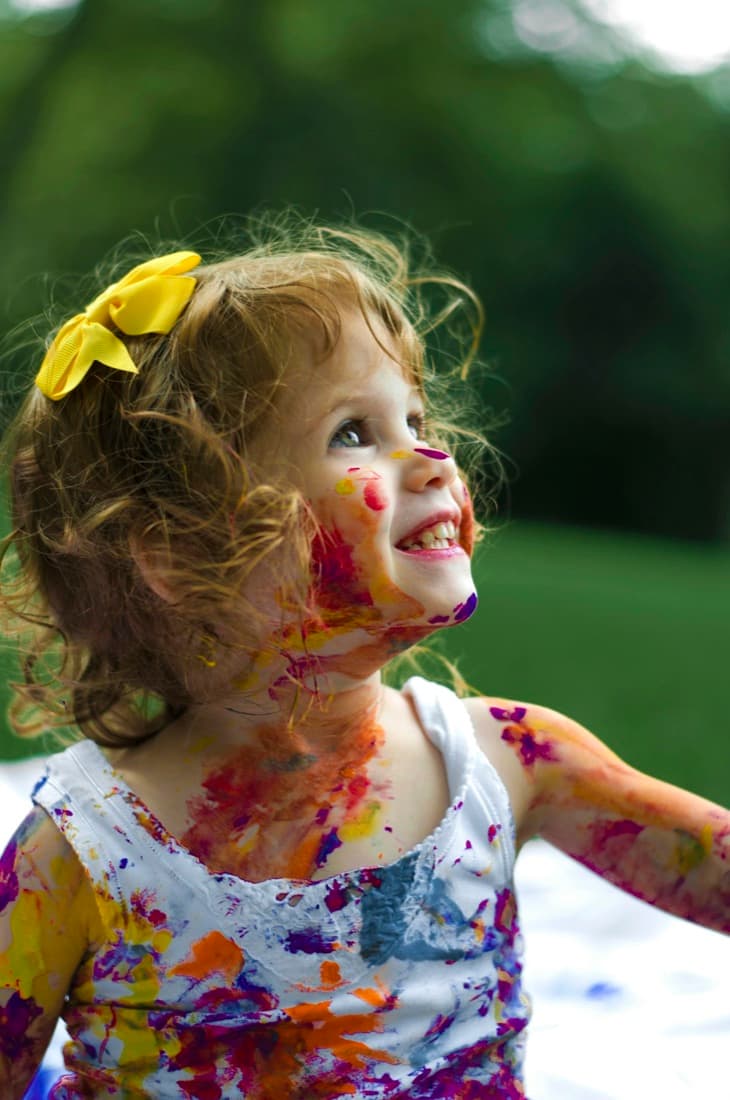
The window is real. Smaller than it feels.
In 1996, developmental psychologist Reed Larson published landmark research tracking how adolescents actually spend their time, and with whom.[1] He found that between the ages of 10 and 18, the time children spend in the company of their parents drops by roughly half. The shift is gradual and almost invisible from inside a family. But it's consistent, and it's real.
Between ages 6 and 10, children orbit their parents naturally. Family is the gravitational centre. By 12, a private world starts forming. By 16, their inner life has largely moved elsewhere: to peers, to screens, to the beginning of an independent self. This isn't failure. It's development. But it does mean the years you have right now carry more weight than most parents realise until they're already past them.
The last time they ask you to draw with them, you won't know it was the last time.
The window when your child thinks you're the most creative person alive, when sitting beside you to make something feels like the best possible way to spend an afternoon, is finite and invisible. You won't see it closing. You'll just notice, one day, that it already has.
What children actually remember
Robyn Fivush, a developmental psychologist at Emory University, has spent decades studying how children form autobiographical memory: the stories we carry about who we are and where we came from.[2] Her findings consistently challenge what parents assume their children will remember.
It is almost never the big events. Not the holidays, not the theme parks, not the birthday parties with the rented bouncy castle. Children remember the texture of repeated experiences. What it felt like to do a particular thing, in a particular place, with a particular person, over and over again. The emotional residue of ordinary time, accumulated.
Fivush's research shows that children who grow up with strong shared narratives (who can tell the story of their family, who have rituals they can describe) demonstrate better emotional regulation, a more stable sense of identity, and greater resilience when things get hard. The memories themselves aren't the point. The pattern they form is.
The stories families tell together about shared experiences become the foundation of a child's sense of self and belonging.
— Based on the family narrative research of Robyn Fivush, Emory University
Think about the memories you carry from childhood. The ones that actually surface. Chances are they're not the exceptional ones. They're a repeated feeling of being somewhere specific with someone specific, doing something ordinary together. That's what accumulates into identity.
The science of family rituals
Barbara Fiese, a developmental psychologist at the University of Illinois, has spent her career studying family rituals and what they actually do for children.[3] In her analysis of more than fifty years of family research, she found something that parents tend to feel but rarely articulate: it isn't the quality of any single parenting decision that predicts child wellbeing most reliably. It's the presence of regular, predictable shared rituals.
The research found that children from families with consistent rituals (dinner together, a weekly activity, a bedtime routine that never really changes) consistently outperformed their peers across a striking range of measures:
- Higher academic achievement
- Fewer behavioural problems at school
- Stronger sense of family identity and belonging
- Better emotional regulation under stress
- Greater resilience during difficult life events
Fiese's explanation for why rituals work so reliably is elegant: they aren't about the activity itself. They're about predictability. A child who knows that every Friday evening they draw with their parent isn't just having fun. They're building a felt sense of safety. A sense that the world is ordered, that they matter enough to be shown up for, week after week, without exception.
Rituals signal to children that they belong, that they are seen, and that there is a rhythm to life they can count on.
— Based on the family rituals research of Barbara Fiese, University of Illinois
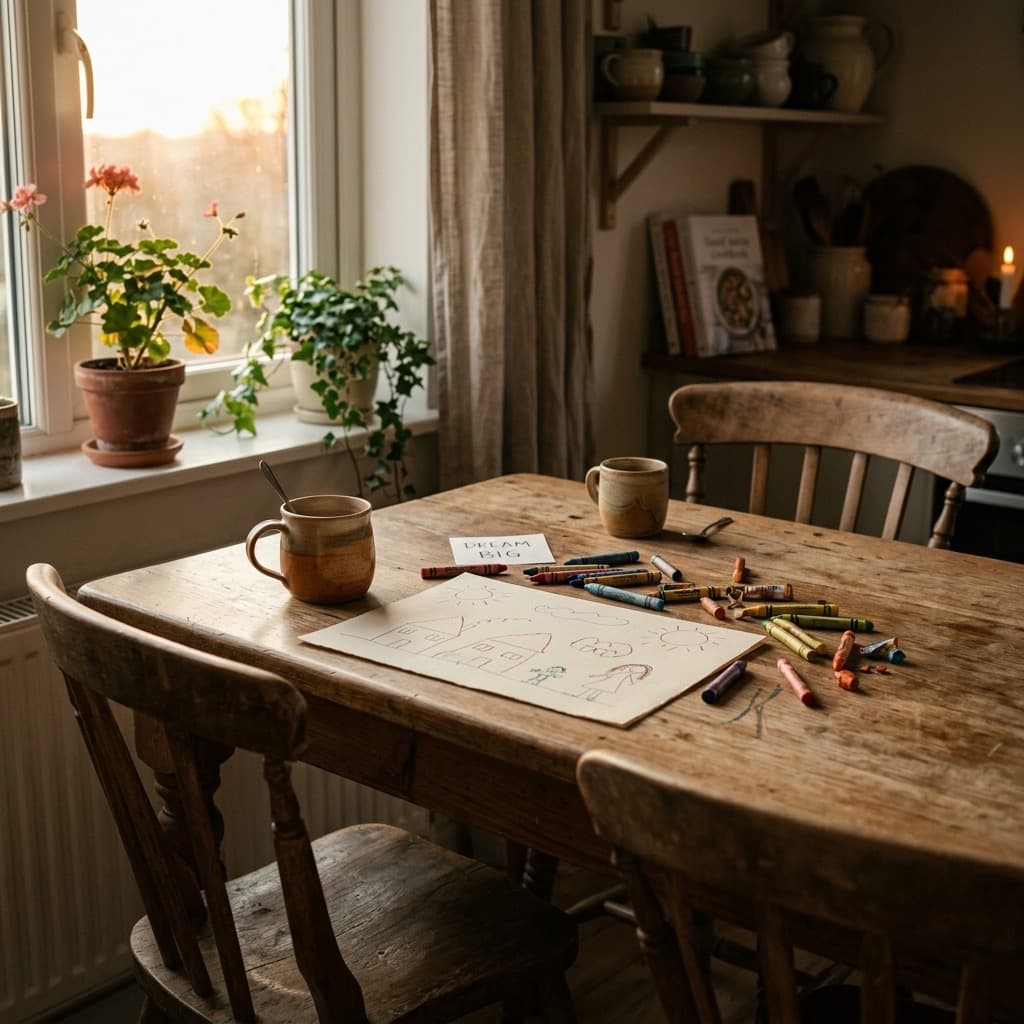
Why side by side beats face to face
There's a reason some of the best conversations happen in cars, on walks, or while making something together. Research in adolescent psychology has consistently found that children, especially as they get older, are significantly more likely to open up during parallel activities than in direct, face-to-face conversation.[4]
The mechanism is simple: face-to-face interaction carries social pressure. Eye contact, body language, the expectation of a response: these create an emotional intensity that can make vulnerability harder. When you're both looking at something else (a drawing, a project, a task), that pressure lifts. The conversation doesn't have to go anywhere. It just can.
Nancy Darling, a developmental psychologist at Oberlin College who has studied adolescent disclosure extensively, found that teenagers are meaningfully more likely to share personal, emotionally significant information with parents during shared activities than during dedicated "let's talk" conversations. The activity gives everyone somewhere safe to look. The drawing, the puzzle, the thing you're making together. It carries the weight so the conversation doesn't have to.
The best conversations you'll have with your child won't start with "we need to talk." They'll start with crayons.
This matters even with young children. A parent and a five-year-old drawing at the kitchen table aren't just making art. They're building a communication pattern. A habit of being side by side, focused on something shared, where talking is easy and silence is comfortable. That pattern, built early, pays forward for years. It becomes the template for how a child learns to be close to another person.
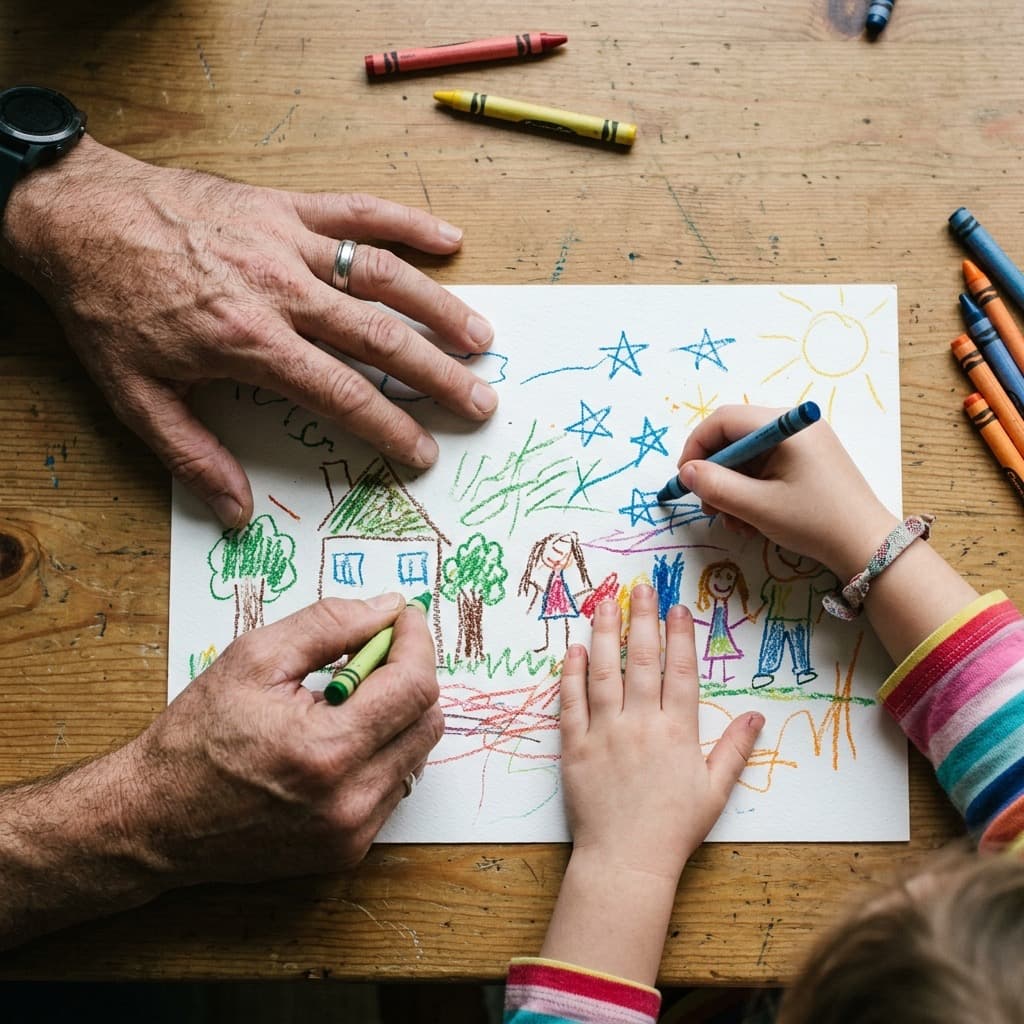
What happens when you create together
The Harvard Center on the Developing Child describes what they call "serve and return" interactions: the back-and-forth exchanges between a parent and child where one initiates, the other responds, and the exchange continues.[5] These interactions, repeated over time, literally build neural architecture. They wire a child's brain for communication, emotional regulation, and deep connection.
Shared creative activity is one of the richest environments for serve and return. Your child draws a dragon. You ask about the horns. They explain. You add a castle. They gasp and reach for the red crayon. Each exchange is a synapse strengthening. A bond deepening, increment by increment, in a way neither of you can see in the moment.
Stuart Brown, a psychiatrist who founded the National Institute for Play and spent decades documenting the science of play across cultures and age groups, argues that creative play between parents and children isn't a luxury or a bonus. It's biologically essential.[6] The neural pathways built through shared creative experience are among the most durable of any we form.
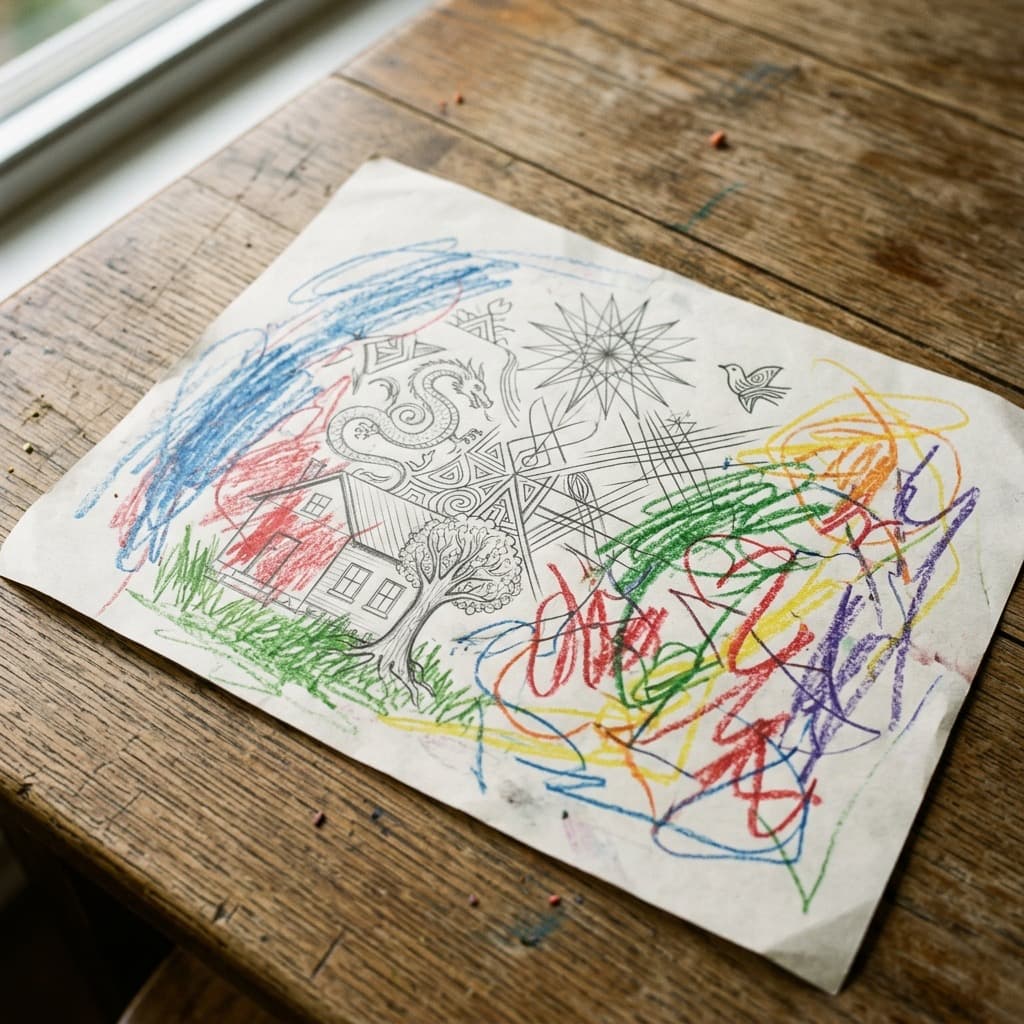
"Do you remember when we used to do this?"
There is a particular kind of memory that psychologists call emotionally significant autobiographical memory: the memories that form the backbone of who we are. They are almost never formed during extraordinary events. They form during moments of repeated emotional resonance. A feeling, revisited enough times, until it becomes part of the story of yourself.
"Do you remember when we used to draw together every Friday?" That sentence, said by a grown child to a parent, is built from a hundred ordinary evenings. A ritual that nobody announced was important. A habit that accumulated, quietly, into something irreplaceable.
You won't know which drawing session becomes the one they remember. You won't know which Tuesday becomes the story they tell their own children one day. You just have to show up for enough of them.
The best memories aren't made on holidays. They're made on the ordinary Tuesday when you sat down and drew dragons together.

Where Sketchra fits in all of this
We didn't build Sketchra to teach children about technology. We built it because we know how hard it is to say yes. Life is full. Evenings go fast. The path of least resistance is always the screen, the task, the "not now."
Sketchra is a reason to sit down. Your child draws something (a dragon, a house, a person who is mostly just a circle with arms) and together you choose a style and watch it become something neither of you expected. The conversation that follows isn't something you planned. It just happens, because you were both there, side by side, looking at the same thing.
The drawing is the excuse. The ritual is the point. The memory is what stays.
The science is clear: it isn't the grand gestures that build lasting bonds. It's the small, repeated moments, the ones your child will carry into adulthood and, one day, pass forward to their own children.
Pick a night. Make it yours. The research says it matters more than you know.
Free to start · No credit card · Takes 30 seconds
Sources & Research
- [1]Larson, R. & Richards, M.H. (1994). "Divergent Realities: The Emotional Lives of Mothers, Fathers, and Adolescents." Basic Books. Follow-up published as: Larson, R. et al. (1996). "Changes in Adolescents' Daily Interactions With Their Families From Ages 10 to 18." Developmental Psychology, 32(4), 744–754.
- [2]Fivush, R. & Haden, C.A. (Eds.) (2003). "Autobiographical Memory and the Construction of a Narrative Self." Lawrence Erlbaum. See also: Fivush, R. (2011). "The Development of Autobiographical Memory." Annual Review of Psychology, 62, 559–582.
- [3]Fiese, B.H. et al. (2002). "A Review of 50 Years of Research on Naturally Occurring Family Routines and Rituals: Cause for Celebration?" Journal of Family Psychology, 16(4), 381–390. See also: Fiese, B.H. (2006). "Family Routines and Rituals." Yale University Press.
- [4]Darling, N. et al. (2006). "Predictors of Adolescents' Disclosure to Parents and Perceived Parental Knowledge." Journal of Youth and Adolescence, 35(4), 667–678.
- [5]Harvard Center on the Developing Child (2007). "The Science of Early Childhood Development." Center on the Developing Child, Harvard University. Serve and return concept: developingchild.harvard.edu.
- [6]Brown, S. & Vaughan, C. (2009). "Play: How It Shapes the Brain, Opens the Imagination, and Invigorates the Soul." Avery/Penguin. National Institute for Play: nifplay.org.